

You file the LLC, hit the line for a registered agent, and pause. Maybe you're working from home, maybe your team is already split across time zones, and maybe the easiest thing in the moment is to type your own address and move on. That one field feels small, but it decides where the state sends lawsuits, tax notices, and official reminders, which is why registered agent services are really a compliance decision, not a clerical one.
The temptation is to treat the role like a cheap mailbox. That framing misses the point. A registered agent is the company's legal intake point, the place where official delivery has to land reliably, in-state, and during business hours so the business can't claim it never got the message (Stripe's overview of registered agent rules).
Why a Registered Agent Matters the Moment You Form Your Company
The formation form can make this look like a small contact detail, but it is really the point where the state asks, “Who can be reached here, at a real street address, for formal notices?” If you form an LLC or corporation without a dependable registered agent, the state still expects someone to receive official mail in the state where the company is formed, and a PO box does not satisfy that requirement (Stripe). In practice, that means the choice belongs in your formation checklist, not your afterthought pile.
What that field actually triggers
A founder often thinks, “I can just use my address for now.” The problem is that the address on file becomes the official intake point for service of process and state correspondence. If that address is tied to a person who travels often, sits behind a mailbox, or is hard to reach during business hours, legal mail can stall before anyone inside the company sees it.
Practical rule: if a notice is serious enough to be delivered formally, it needs a stable in-state street address attached to it.
For remote teams and founders forming in one state while living in another, the filing decision carries more weight. The registered agent requirement follows the entity wherever it is formed or registered to do business, and the company still needs a reliable in-state contact point for official delivery (this founder guide). If you are qualifying in multiple states, that setup has to work in each place where the company is on file.
The easiest way to understand it is simple. Your ordinary business email can be messy and still function. Your registered agent address cannot be messy, because a missed delivery can become a legal problem instead of a delayed reply.
Why founders underestimate the risk
Many founders treat the role as a privacy line item. Privacy matters, but it is secondary. The main job is to make sure service of process and government notices reach the company on time, so the business has a chance to act before deadlines pass. That is why the requirement belongs in the same mental bucket as the rest of your formation paperwork, including the state rules you file under and the official contact details you give the government (Stripe).
If your company is set up from day one with a stable registered agent, the rest of your filings have a cleaner path. If you are still putting the launch sequence together, the launch guide for founders is a useful companion for the early operational steps that sit next to entity setup.
What a Registered Agent Does Day to Day
A registered agent works like the company's legal front desk. During business hours, it receives hand-delivered lawsuits, certified state mail, and official notices, then moves them to the right person inside the business without delay. That forwarding step matters because the company usually gets only one chance to respond before a missed notice turns into a bigger legal or compliance problem.
The daily workflow behind the scenes
The agent keeps a physical street address in the state and stays available when someone tries to serve the company. In practice, that means accepting documents, logging them, and sending them to the owner, operations lead, or counsel quickly. The agent usually does not draft responses or give legal advice. Its job is to make sure the company sees the paper before a deadline passes.
That intake role covers more than lawsuits. State reminders, annual report notices, franchise tax letters, and Department of Revenue correspondence often travel through the same channel. If those documents sit unnoticed because someone was traveling, the office was closed, or the address was out of date, the company can miss a filing window even though the notice arrived where it was supposed to.
The registered agent is not the legal team. It is the front door. If that door does not stay open during business hours, deliveries start piling up where no one is watching them.
Washington's Secretary of State guidance shows how closely this role is tied to formal compliance, since updates to registered agent information often happen through annual-report windows or amendment filings (Washington Secretary of State guidance). The point is simple. The agent record is part of compliance, not a side note.
What founders experience
Founders usually do not interact with the registered office every day. They see the output instead. A scanned notice appears in a dashboard. A filing reminder lands in email. A legal letter gets forwarded before the deadline expires. The value is not just that the business has a mailing address. It is that the business has a reliable chain of custody for official documents.
That matters even more for remote teams, companies with no fixed office, and businesses operating in several states. A commercial agent reduces the odds that one founder, employee, or cofounder has to be physically present at exactly the right time. In a multi-state setup, that coverage helps keep compliance from depending on one person's calendar, travel plans, or time zone.
Acting as Your Own Agent vs Hiring a Commercial Service
A registered agent decision looks simple on paper. In practice, it affects whether your company can reliably receive legal notices on a normal Tuesday, or whether that job depends on one founder being in the right place at the right time.
Self-appointment can work, but it turns availability into part of your compliance system. A commercial service costs money, yet it replaces a person-centered setup with a documented process for intake, scanning, and forwarding.
| Dimension | Self-Appointed Agent | Commercial Registered Agent Service |
|---|---|---|
| Public address | Your home or office may appear on the record | The provider's in-state address is used instead |
| Availability | You or a named person must be reachable during business hours | The service maintains coverage during business hours |
| Cost | Often no extra annual fee beyond state filing costs | Recurring annual fee |
| Privacy | Better if you keep the address private, but only if you stay available | Stronger privacy by default because the provider's address is public |
| Remote work | Travel, meetings, and time zones create coverage gaps | Designed for founders who aren't tied to one desk |
| Multi-state use | Hard to maintain across states where you qualify to do business | Easier to keep consistent across states |
| Compliance tools | You must track deadlines yourself | Many providers bundle scanning, alerts, and document portals |
When DIY makes sense, and when it doesn't
DIY works best when the founder is local, reliably available, and comfortable being the public point of contact. It can also fit owners who want the fewest outside vendors and do not mind their address becoming part of the public record.
That setup starts to strain once the business becomes remote-first, founder-light, or active in more than one state. The legal requirement stays the same. A notice still has to reach a physical in-state location during business hours, even if the team is spread across Slack, Zoom, and airports.
A commercial service usually makes more sense when offices move, founders travel often, or compliance is shared across jurisdictions. A registered agent is like the company's compliance mailbox at the front desk. If that front desk is also your kitchen table, your coworking pass, or a hotel lobby, the system depends on too many moving parts.
The decision rule
Use self-appointment if one person can stay present, reachable, and willing to use that address for every required state. Use a commercial service if that answer depends on vacations, shared workspaces, time zones, or hoping someone notices a letter before a deadline passes.
How Much Registered Agent Services Really Cost
A registered agent is one of those compliance costs that looks small until it sits next to state filings, foreign qualification, and the mess of keeping notices moving across a remote team. The service fee is only one part of the bill, but it is the part founders usually see first. Thomson Reuters notes that annual pricing often falls in the $100 to $500 range, while some providers give the first year away and others charge much more for bundled offerings (Thomson Reuters). The legal job stays the same. The packaging does not.
A simple way to budget the decision
A solo founder in one state may focus on the sticker price and stop there. A company that operates in several states has to think about where it is qualified to do business, because the registered agent requirement follows each state where the company is formed or registered. That is where the budget pressure comes from, since the service fee sits inside a larger compliance system.
Here is a cleaner way to compare options.
| Scenario | Annual Fee | 5-Year Total | Hidden Costs |
|---|---|---|---|
| Single-state LLC using a paid provider | The provider's annual rate | Five annual renewals | Possible formation bundle markup, state filing fees |
| Multi-state company using one service per state | Per-state renewal in each jurisdiction | Five years across all states | Foreign qualification fees, state reports, more admin time |
| Self-appointed agent | No provider fee | No service fee | Privacy trade-off, coverage risk, possible missed notice consequences |
Renewal pricing deserves more attention than the signup offer. Some providers make the first year look cheap, then shift the economics on renewal. That matters because the agent usually becomes part of the company's ongoing compliance stack, not a one-time purchase.
A worked founder example
A Delaware LLC with one founder and one state to manage may prefer certainty over a small savings. Paying a clear annual fee can be easier than risking missed mail or putting a home address into the public record. That is especially true when the founder travels, works from shared spaces, or relies on a remote team to notice administrative mail.
A five-state operating company should treat the agent fee as compliance overhead. Each state adds another place where official notices can arrive, and each location needs coverage that does not depend on someone being at a desk at the right moment.
Reality check: the cheapest service is not the cheapest setup if it creates missed notices, rushed fixes, or a public-record privacy problem later.
If you are separating launch costs from recurring operating costs, this pricing page is a useful place to compare the shape of the spend.
How StartGlobal Can Help
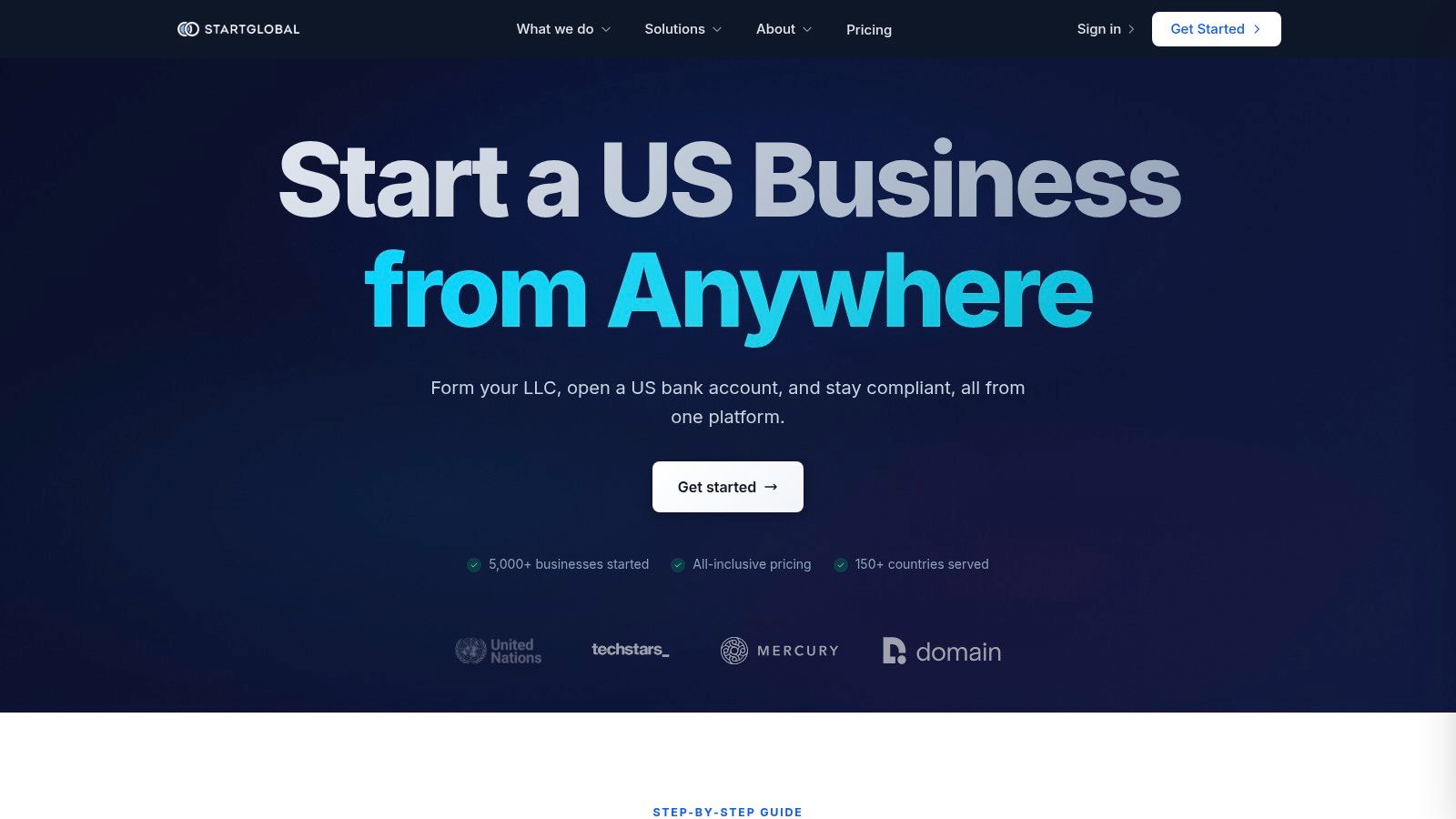
For founders who want the registered agent decision bundled into a broader operating setup, StartGlobal is worth a close look. It forms and manages U.S. LLCs for founders worldwide, with a fully online process that doesn't require a U.S. visit or a Social Security Number. That matters most when the underlying problem isn't just appointing an agent, but building the rest of the compliance and banking workflow around it.
Where it fits in the founder workflow
StartGlobal covers the early sequence most first-time founders have to assemble from separate vendors. Its package includes LLC formation in any U.S. state, first-year registered agent service, and a state name availability check. It also prepares and submits the EIN application, supports remote bank account setup, and offers ongoing registered agent coverage with legal mail receipt, scanning, and forwarding.
It goes beyond the statutory basics with annual or biennial report preparation, deadline monitoring, bookkeeping, and federal tax filing support. For a founder who wants one place to track formation, compliance, and routine admin, that's where the value lies. The trade-off is that this kind of integrated setup is broader than a bare-bones registered agent offer, so it makes the most sense when you want workflow support, not just a mailing address.
Why founders compare it to other agent options
If you're only shopping for the least expensive registered agent line item, StartGlobal may be more platform than you need. If you're a non-resident founder, a remote-first team, or someone trying to avoid stitching together separate tools for compliance, banking, and communication, the integrated approach is a stronger fit. Their US registered agent services page is useful if you want to compare how a broader service stack differs from a single-function provider.
The screenshot above also tells a practical story. StartGlobal's model is designed around an online dashboard rather than a loose collection of disconnected tasks, which is the point when your company's legal mail, filing reminders, and operating tools all need to live in one system.
Appointing and Switching Your Registered Agent Step by Step
Changing or appointing a registered agent is usually a short project, not a saga, if you do it in the right order. The mistake founders make is signing up with a provider first and checking the state record later. That can create a mismatch between what the provider thinks it's handling and what the state recognizes.
The afternoon checklist
- Confirm the agent can serve in the state. The provider has to meet the state's eligibility rules and maintain a physical street address there.
- Read the consent language. Most states require written consent before the appointment becomes effective.
- File the state form. Depending on the state, that may be part of formation paperwork or a separate change-of-agent filing.
- Pay the filing fee. The state's own fee is separate from the provider's annual charge.
- Update your internal records. Amend your operating agreement, bylaws, banking records, or permit files if they reference the prior agent.
- Verify the update. Check the Secretary of State database and save the new account credentials.
What to watch for before you file
The biggest red flag is assuming the provider's signup page automatically changes the state record. It doesn't. The state filing is what matters. If your company is already formed, the appointment or change has to be reflected in the official record before you treat the switch as done.
Don't announce the new agent to lenders or partners until the state record matches the file you keep internally.
The other thing founders miss is continuity. If you're moving offices, closing a coworking arrangement, or shifting from one remote setup to another, make sure the new agent is live before the old one becomes unreliable. That order keeps the company from drifting into a period where nobody is clearly designated to receive formal notices.
Choosing a Provider With Criteria That Hold Up in 2026
A lot of buyers start with price and end with regret. The better framework is to compare provider archetypes, because the cheapest option isn't always the best fit for a remote founder, and the fanciest dashboard isn't always the most reliable compliance layer.
The six criteria that matter
- Multi-state coverage: Can the provider support every state where you're formed or qualified?
- Compliance alert quality: Does it flag deadlines clearly, or just store mail?
- Document handling speed: How fast does mail reach the people who need it?
- Privacy posture: Does it protect your home address without hiding the actual legal function?
- Software integrations: Does the service fit into your operating tools cleanly?
- Transparent renewal pricing: Is the renewal price easy to see, or does it jump later?
Those criteria matter because founders don't just buy an address. They buy a process. If the provider can't give you stable intake, clear reminders, and transparent renewals, the service may look fine at signup and turn noisy by year two.
Three provider archetypes to consider
Lean compliance file. Best for founders who want a straightforward statutory function and not much else. This is the simplest model if you already have internal systems for deadlines and document handling.
Full-stack legal platform. Best for remote-first founders who want registered agent service tied to dashboards, reminders, and other operational tools. It's heavier, but it can reduce the number of separate vendors you manage.
Boutique local firm. Best for businesses that want human support and a narrower service relationship, especially when the company is centered in one state and values a familiar contact.
Red flags that should slow you down
- Providers that hide the physical address, because the role depends on a real street location.
- Offshore mail-forwarding fronts, because the service has to be legitimate in the state where the entity is operating.
- Aggressive renewal markups, especially when the first-year price looks much lower than the ongoing bill.
The right choice in 2026 is the one that matches your operating shape. A solo founder in one state, a remote team with no office, and a multi-state SaaS company all need the same legal function, but they don't need the same delivery model.
Common Misconceptions That Quietly Increase Legal Risk
The biggest mistake isn't choosing the wrong provider. It's choosing the right provider for the wrong reason. Founders often start with privacy, then ignore the operational part of the job, and that's where the risk begins.
Four myths founders repeat
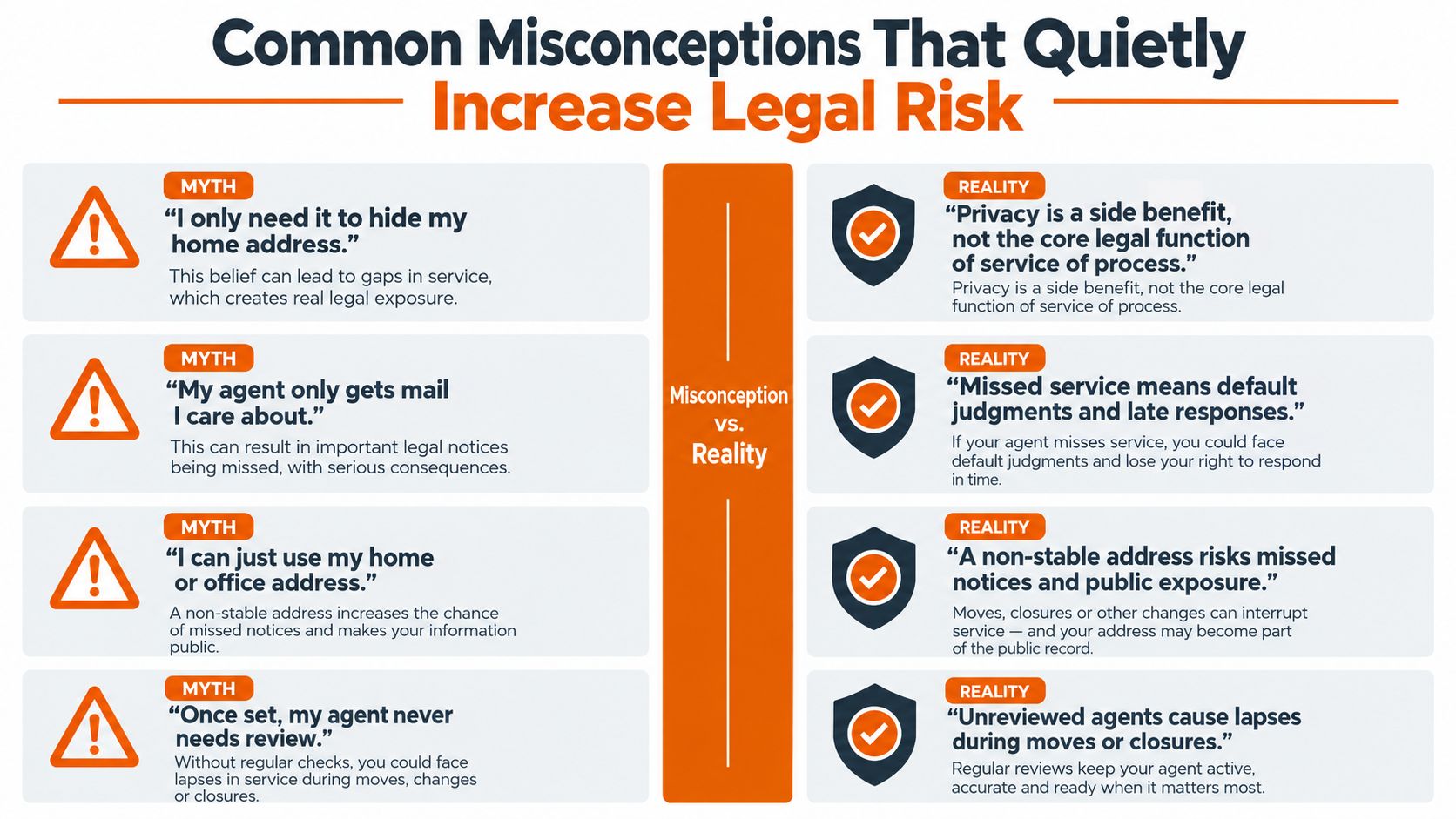
Myth 1, “I only need it to hide my home address.” Privacy helps, but the main job is receiving legal notices on time. If you stop paying attention after the address is off the filing, you can still miss the notice that matters most.
Myth 2, “My agent only gets mail I care about.” The agent gets the things that are easy to ignore until they become expensive. If the forwarding step is slow, deadlines don't care why.
Myth 3, “I can just use my home or office address.” Sometimes you can serve as your own agent, but the address still has to be stable, physical, and available during business hours. A coworking desk, mailbox, or temporary office doesn't solve the legal requirement.
Myth 4, “Once set, my agent never needs review.” Moves, closures, vendor changes, and new-state expansion all change the risk profile. A registered agent should be reviewed whenever the company's footprint changes.
What fails next when the myth is wrong
If you treat the service as a privacy hack, the first failure is usually a missed notice. If you treat any address as acceptable, the first failure is usually noncompliance with the state's physical-address rule. If you stay DIY while the company grows across states, the first failure is often a gap you don't notice until someone serves papers at the wrong place. And if you assume the agent covers everything, you'll still be responsible for reports, taxes, and license renewals.
The conclusion is simple. The registered agent is one piece of the compliance stack, not the whole stack.
Frequently Asked Questions and Your Next Steps
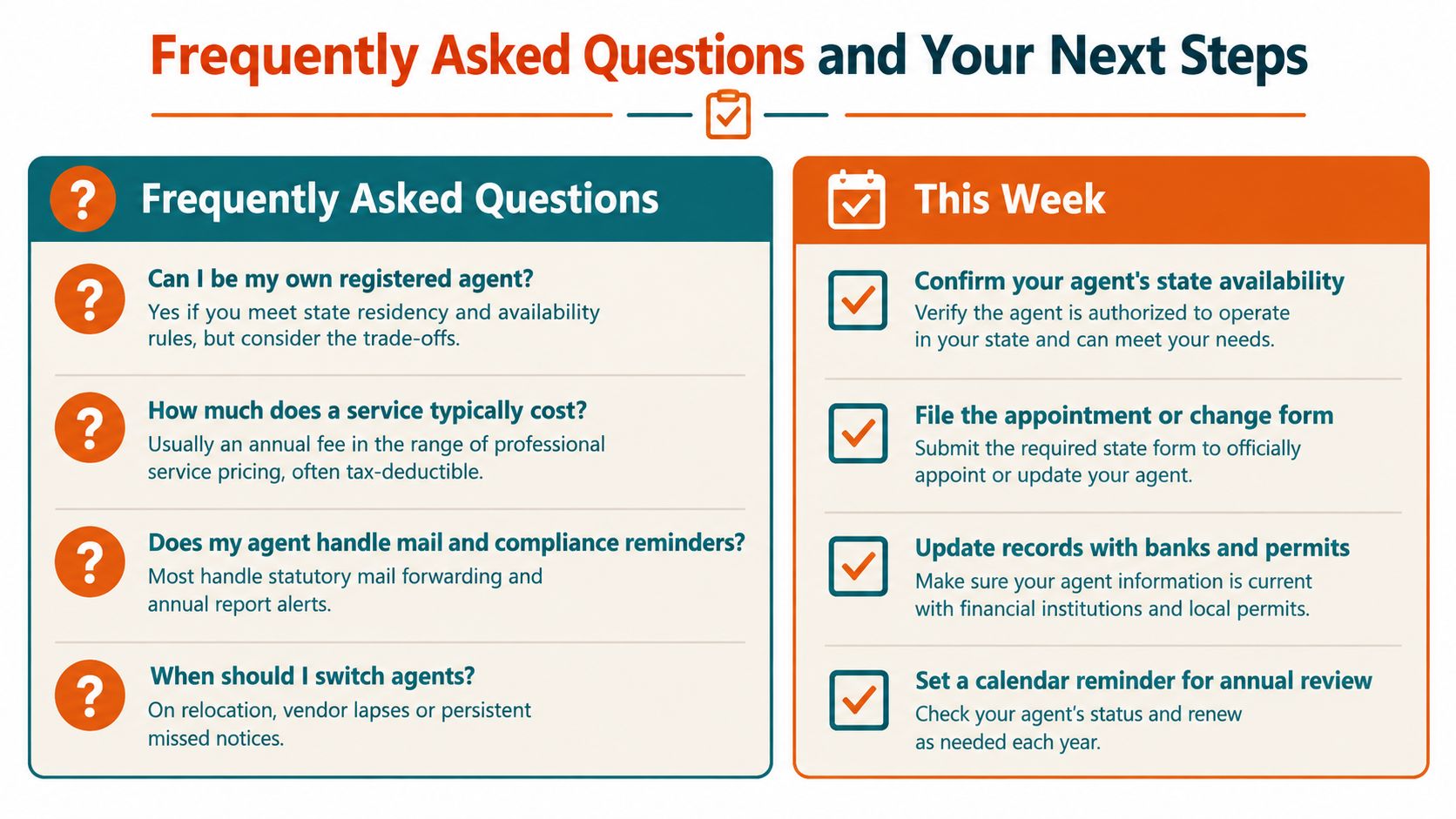
A founder can serve as their own registered agent in many states if the residency, physical-address, and availability rules line up, but that choice gets less comfortable once travel, remote work, or privacy enter the picture. It is a bit like using your personal phone number for every client call. It works until the volume, the interruptions, and the risk of missing something important start to grow.
Changing registered agents is usually a routine state filing, but it should also show up in your internal records, vendor files, and compliance calendar. For filing windows, resignation procedures, and state-specific FAQs, see the MakerHunt FAQ.
If an agent cannot be reached, or resigns without warning, notices can sit unclaimed long enough for a default or cure process to begin. A simple example is a state that gives a short cure period after a missed filing notice, but that window only helps if someone sees the notice in time. Continuity matters more than a low annual fee.
The service fee is separate from the state filing fee, so a renewal invoice or formation bundle should not make you think you are paying twice for the same item.
This week's checklist
- Confirm your current agent on file. Check the Secretary of State record and make sure the entity name, address, and appointment status match your internal records.
- Set annual report reminders. Put the filing deadlines on a calendar your team uses regularly, not one that sits unread.
- Audit multi-state exposure. Compare where the business operates, hires, or signs contracts against where it is registered.
- Shortlist two providers. Use the criteria above, then verify how each one handles resignations, notices, and state changes.
If your company is about to hire its first remote employee in a new state, revisit the registered agent decision before that hire goes live. The legal footprint changes the moment the business does.