
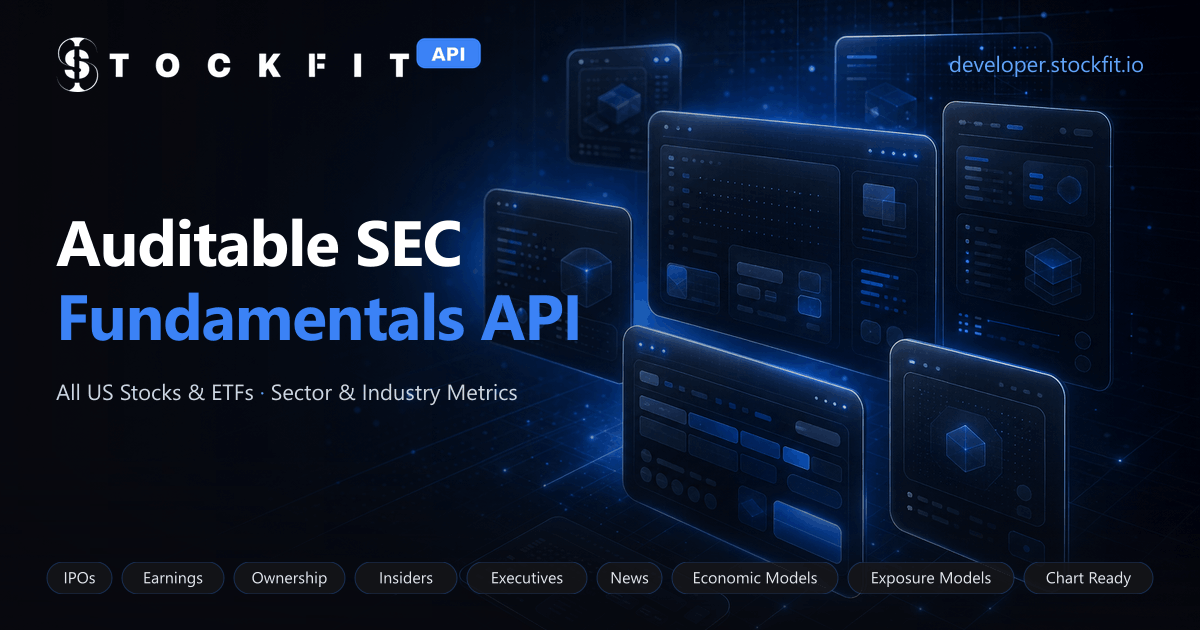
Unpacking Financial Data: The Shift Towards Accessibility
In the ever-evolving landscape of finance and fintech, the demand for accessible, structured financial data has never been more critical. As markets become increasingly complex, the need for reliable data sources that cut through the noise is paramount for financial analysts and indie developers alike. This trend underscores a significant pain point in the industry: the traditional data providers often cater to large enterprises, leaving smaller teams grappling with high costs and complex interfaces. The emergence of solutions like StockFit API signals a shift towards democratizing financial data access, allowing smaller players to compete with the giants.
The Data Dilemma: Challenges in Financial Analysis
Financial professionals and developers often face the daunting task of sourcing accurate and up-to-date financial data. Traditional methods involve navigating cumbersome enterprise-level solutions that are not only costly but also require significant technical expertise to integrate. This complexity creates a barrier to entry for smaller developers and analysts who need streamlined access to data for timely decision-making. Existing tools often fail to offer the granularity or flexibility needed for nuanced financial analysis, leaving users to cobble together information from disparate sources.
Innovative Approaches: How Builders Are Addressing the Gap
In response to these challenges, new solutions are emerging to fill the gap left by traditional providers. StockFit API exemplifies this trend by offering a RESTful API that delivers comprehensive financial data sourced directly from SEC filings. Designed for quant researchers, financial analysts, and indie app developers, it provides essential financial statements, insider trade data, and more, all in a format that's straightforward to integrate into various applications. This approach not only reduces complexity but also empowers smaller teams to leverage high-quality data.
StockFit API in Practice: Real-World Applications
StockFit API is built to seamlessly integrate into the workflows of financial professionals. Consider a quant researcher developing a predictive model for stock performance: they can use StockFit API to access income statements and balance sheets, ensuring their model is grounded in accurate, up-to-date financials. Similarly, an indie app developer creating a portfolio management tool can leverage the API's ETF holdings data to provide users with real-time insights into fund compositions and flows. The API's ability to deliver chart-ready data and health scores further enhances its utility, allowing developers to create visually compelling and informative interfaces.
What Sets StockFit API Apart
The differentiation of StockFit API lies in its accessibility and pricing model. Unlike traditional data providers, it offers a free tier with one year of historical data, allowing users to explore its full capabilities without financial commitment. This tiered approach ensures that even the smallest teams can access high-quality data while scaling up as their needs grow. Furthermore, its integration capabilities with popular AI tools like Claude and VS Code provide added flexibility for developers looking to enhance their analytical capabilities.
Who Should Pay Attention to StockFit API?
The StockFit API is particularly relevant for quant researchers, financial analysts, and indie developers who require reliable and structured financial data. Its user-friendly interface and pricing model make it an attractive option for small teams and indie founders who want to integrate financial data into their applications without the overhead of traditional solutions. If you're part of a team looking to build data-driven financial tools, StockFit API presents a compelling option.
About the Builder: Andy Reimann
Andy Reimann, the mind behind StockFit API, brings a deep understanding of the nuances in financial data analysis. His motivation stems from a desire to simplify access to quality financial data for smaller teams and developers who often find themselves priced out of traditional solutions. Reimann's vision is to level the playing field, making it possible for indie developers and small teams to compete with larger financial institutions by providing them with the same data access capabilities.
Looking Ahead: The Future of Financial Data Access
As the financial industry continues to embrace digital transformation, the need for accessible, high-quality data will only grow. Products like StockFit API are paving the way for a more inclusive financial ecosystem, where data-driven decisions are not the sole domain of large enterprises. This democratization of data access invites a broader range of players to innovate and compete, potentially reshaping how financial analysis is conducted. The question remains: how will further advancements in AI and machine learning continue to enhance these capabilities?
Explore the Launch
To explore the capabilities of StockFit API and see how it can enhance your financial analysis and application development, visit the StockFit API website. This innovative product has launched on MakerHunt, where you can find more details about its features and pricing. Check out the project page on MakerHunt to learn more about this and other groundbreaking launches. If you're a founder with a similar project, consider submitting your launch to MakerHunt.
Quick Answers
What is StockFit API?
StockFit API is a data vendor that offers structured financial data sourced from SEC filings. It provides users with essential financial statements and insights necessary for informed financial decision-making.
Who is StockFit API designed for?
This API is tailored for quant researchers, financial analysts, and app developers who require reliable financial data for their applications or analyses. It is especially beneficial for small teams and indie developers.
How does the StockFit API pricing model work?
The pricing model is tiered by history, offering a free tier with one year of data history available without a credit card. Higher tiers provide access to more than 20 years of historical data, making it scalable for growing needs.
